On this page
Creating a positive classroom environment takes more than setting rules and responding when something goes wrong. Elementary students are still developing the communication, self-regulation, and social skills they need to participate successfully in classroom life.
For teachers, balancing these needs with academic goals, lesson preparation, and a busy school day can be challenging. Some students may struggle with transitions, find independent work overwhelming, or need additional support to communicate their feelings.
Positive behavior support in the classroom offers a proactive approach. Instead of focusing primarily on correcting unwanted behavior, teachers teach expected skills, establish predictable routines, recognize positive progress, and make adjustments that help students participate.
Small, consistent changes can make classroom expectations easier to understand and daily routines more manageable. Here are 10 practical strategies you can adapt to your elementary classroom.
What Is Positive Behavior Support in the Classroom?
Positive behavior support is an approach to creating environments where students can learn expected behaviors and receive appropriate support when they struggle.
Rather than assuming a student is deliberately being difficult, teachers consider what is happening around the behavior and what skills or adjustments might help.
Positive behavior support typically involves:
- Teaching expectations: Explaining and modelling what appropriate behavior looks like.
- Creating predictable routines: Helping students understand what happens next and what they need to do.
- Recognizing positive behavior: Giving specific feedback when students demonstrate expected skills.
- Understanding context: Considering task difficulty, transitions, communication needs, and classroom conditions.
- Teaching replacement skills: Helping students practise asking for help, taking a break appropriately, or expressing frustration.
- Reviewing progress: Observing whether strategies are helping and adapting them when necessary.
Positive behavior support is different from an approach that relies mainly on punishment after problems occur. It emphasizes prevention, skill development, positive relationships, and constructive responses.
Schools may also use Positive Behavioral Interventions and Supports (PBIS), a broader, tiered framework for supporting student behavior across schoolwide, classroom, and individualized levels. A teacher can use positive classroom practices without implementing a complete schoolwide PBIS system.
No single strategy works for every student or situation. Effective support requires attention to individual needs, classroom context, and progress over time.
10 Positive Behavior Support Strategies Teachers Can Use Every Day
1. Establish Clear and Positive Classroom Expectations
Students need to know what appropriate behavior looks like in specific situations. Broad instructions such as “Be good” or “Show respect” may be difficult for younger children to interpret.
Create three to five clear, observable expectations using language students understand.
For example:
- Listen when someone is speaking.
- Use classroom materials safely.
- Ask for help when you need it.
- Treat classmates respectfully.
- Follow the steps for putting materials away.
Displaying expectations is only the first step. Teach each one explicitly, demonstrate examples, let students practise, and revisit the expectations throughout the year.
Classroom example: Before a group activity, demonstrate how to take turns, share materials, and disagree respectfully. Briefly review these behaviors before students begin working together.
Clear expectations give students something specific to practise and give teachers a consistent way to provide reminders.
2. Build Predictable Daily Routines
Unclear or frequently changing routines can leave students unsure about what to do next. Predictable classroom routines help make the school day easier to navigate.
Establish consistent procedures for arrival, independent work, transitions, cleanup, and dismissal. Teach routines step by step rather than assuming students will learn them automatically.
For example, a morning routine might involve:
- Hang up your backpack.
- Put your folder in the designated tray.
- Check the daily schedule.
- Begin the morning activity.
Practise the sequence with students and keep written or visual reminders where they can easily see them.
Classroom example: If students often crowd around the teacher after arriving, display a four-step morning checklist. Point to each step while teaching the routine, then gradually encourage students to follow it independently.
Review routines after holidays, schedule changes, or periods when students need a reminder.
3. Use Specific, Genuine Positive Reinforcement
Positive reinforcement in the classroom involves recognizing behavior in ways that encourage students to use the skill again. It can include specific verbal feedback, positive attention, or an agreed-upon reward.
The feedback should identify what the student did rather than simply judging the result.
Compare these examples:
- Vague: “Good job!”
- Specific: “You checked the directions and started the first question independently.”
- Vague: “You're being good today.”
- Specific: “You waited for your turn and listened while your classmate was speaking.”
Classroom example: During independent mathematics practice, notice students who begin using their checklists or ask for help appropriately. Give brief, sincere feedback about the skill they demonstrated.
Recognize effort, improvement, and appropriate strategies, not only perfect performance. Avoid turning every positive action into a transaction or making students feel they must earn approval for ordinary participation.
4. Use Visual Schedules and Behavior Reminders
Visual supports make information easier to refer to without requiring students to remember every verbal instruction.
Depending on student needs, useful options include:
- A daily visual schedule.
- Picture cards for classroom routines.
- A checklist for independent work.
- A first-then reminder.
- A visual reminder of classroom expectations.
Some students benefit particularly from visual information, although the most useful format varies. A photograph, simple drawing, written checklist, or combination of these may be appropriate.
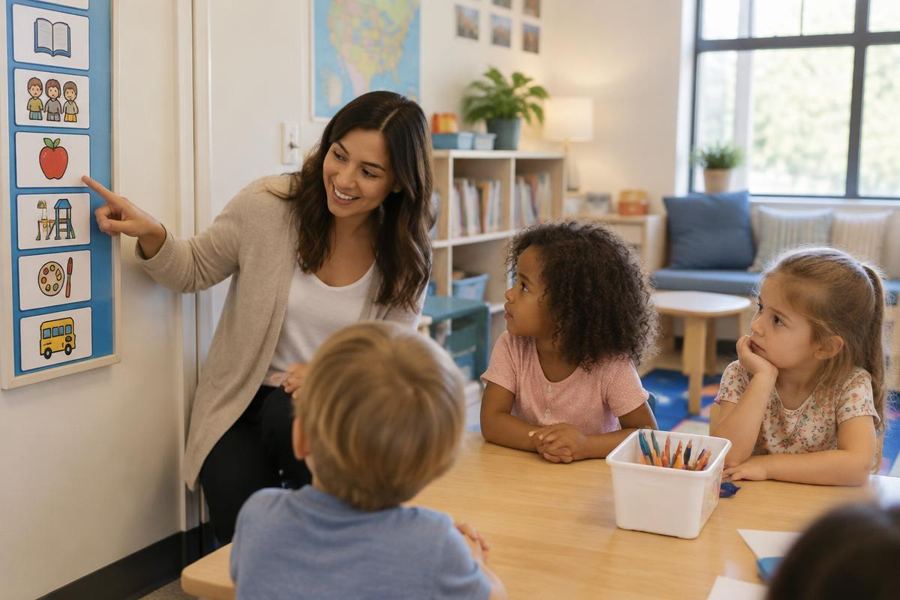
Classroom example: Before a transition, point to the schedule and show students that reading follows mathematics. A student who needs additional structure might also use a small checklist showing the steps for packing away mathematics materials.
Introduce visual supports deliberately. Explain what each image means, demonstrate how to use it, and keep it accessible.
Visuals should support understanding and independence, not become another set of instructions students are expected to interpret without guidance.
5. Teach and Practise Emotional Regulation
Recognizing emotions and choosing an appropriate response are skills students develop over time. Telling a frustrated child to “calm down” may not provide enough guidance about what to do next.
Teach simple strategies when students are calm so they have opportunities to practise before difficult moments arise.
Depending on the student's age and needs, strategies may include:
- Taking a few slow breaths.
- Asking a trusted adult for help.
- Using words or a visual card to communicate a feeling.
- Drawing or writing about an emotion.
- Requesting an appropriate break.
- Spending a short period in a designated quiet space with suitable supervision.
Classroom example: During a calm part of the day, practise a simple phrase students can use when frustrated: “I need help with this.” Explain how students can request a break and what they should do when they are ready to return.
A calm space should support regulation, not serve as punishment or humiliating isolation. Teachers should follow school policies and any relevant individualized support plans.
6. Make Transitions Easier
Moving from one activity to another can be difficult when students are absorbed in a task, unsure what comes next, or not ready to switch their attention.
Make transitions more predictable with advance warnings, visual countdowns, concise directions, and materials prepared before the change.
Classroom example: Before moving from mathematics to reading, say, “You have two minutes to finish your current question. Then put your mathematics materials in your desk and bring your reading book to the carpet.” Display the next activity on the schedule.
For younger students, a familiar transition song or visual timer may also help.
If transitions remain difficult, observe whether the time available is realistic, the instructions are clear, or a student needs additional preparation. Repeating louder instructions may not address the underlying difficulty.
7. Break Difficult Tasks Into Manageable Steps
A long, unclear, or challenging assignment can make it difficult for some students to know how to begin. What looks like refusal may sometimes reflect confusion, frustration, or a task that needs adjustment.
Try:
- Giving one or two instructions at a time.
- Showing an example of the expected result.
- Breaking longer assignments into smaller sections.
- Providing a visual checklist.
- Checking understanding before independent work.
- Offering appropriate movement breaks or choices.
Classroom example: Instead of telling a student to “Write your paragraph,” break the assignment into smaller steps:
- Choose a topic.
- Write one opening sentence.
- Add two supporting details.
- Reread the paragraph.
- Check the final sentence.
The student can tick off each step as it is completed.
Adjust the amount of support based on the student's progress. The goal is to make participation manageable while gradually building independence, not to remove all challenge from learning.
8. Encourage Student Choice and Participation
Appropriate choices can give students a sense of ownership while keeping learning objectives and classroom expectations clear.
Offer two or more acceptable options rather than an unlimited choice that makes the task confusing.
Examples include:
- Choosing between two writing topics.
- Deciding which of two assigned tasks to complete first.
- Selecting a suitable place to work.
- Choosing whether to demonstrate understanding through drawing or writing when both meet the learning objective.
Classroom example: A student is reluctant to begin a writing assignment. The teacher says, “Would you like to write about the school garden or your favorite animal?” Both options meet the same writing objective.
Choice does not mean students can opt out of every expectation. It gives them an appropriate way to participate within clear boundaries.
9. Respond to Challenging Behavior Calmly and Consistently
When a student struggles, the immediate priority is to maintain safety and respond in a way that does not unnecessarily escalate the situation.
A practical response may involve:
- Keeping your voice calm and your instructions brief.
- Giving the student time to process what you said.
- Avoiding public arguments, threats, or humiliation.
- Addressing immediate safety concerns according to school procedures.
- Discussing the incident privately when appropriate.
- Helping the student practise a more appropriate response once they are ready.
Classroom example: A student pushes their worksheet away and refuses to continue. Instead of debating in front of classmates, the teacher calmly says, “Let's pause. I'll help you with the first question.” The teacher then considers whether the instructions or task difficulty need adjustment.
This response does not mean ignoring unsafe behavior or removing necessary boundaries. Teachers should follow school policies and seek assistance when safety is at risk.
If concerns persist or become serious, collaborate with the student's family, special education team, school support staff, or other qualified professionals. Teachers can observe and document behavior without diagnosing students or assuming they know its cause.
10. Track Progress and Reflect on What Works
When a strategy does not appear to help, it is useful to review what actually happens rather than simply repeating the same response.
Brief, objective observations can help teachers identify patterns and decide whether support needs to change.
Record information such as:
- The skill or behavior being practised.
- The activity or context.
- The support provided.
- The student's response.
- Any adjustment to try next.
Classroom example: A teacher notices that one student has difficulty beginning independent work. For several days, the teacher records when the difficulty occurs, whether the directions were clear, and whether a visual checklist or brief check-in helps.
The observations may suggest that the student begins more readily when the first step is demonstrated. The teacher can test that support and review the results.
Keep records respectful, factual, and private. Avoid public rankings or labels that shame students. Share information only with appropriate people according to school policies.
Example: A Simple Positive Behavior Support Plan
Consider a hypothetical Grade 2 student who often takes several minutes to begin independent work.
The teacher notices the pattern and develops a simple plan to explore possible supports.
| Plan element | Example |
|---|---|
| Observed challenge | The student often does not begin the assigned task after whole-class instructions. |
| Possible factors to explore | The student may be unsure how to start, may have missed an instruction, or may find the task difficult. These are possibilities to investigate, not conclusions. |
| Desired skill | Begin the first task step after checking the instructions or asking for help. |
| Preventive support | Provide a short visual checklist, explain the first step, and check understanding before independent work. |
| Positive reinforcement | Recognize when the student checks the list, begins a step, or appropriately requests assistance. |
| Progress monitoring | Briefly record when the student begins and which supports were used. Review the pattern and adjust as needed. |
This example is illustrative, not a diagnosis or a one-size-fits-all intervention. The teacher should gather context before assuming why the behavior occurs and involve appropriate school professionals when additional support is needed.
How to Use Classroom Behavior Charts and Reward Systems Effectively
Classroom behavior charts, reward systems, and individual progress trackers can help make a target skill visible. Their usefulness depends on how they are designed and used.
For a supportive system:
- Choose one clear target. For example, beginning the first task step or using an agreed-upon way to ask for help.
- Make the goal achievable. Start with a realistic expectation and adjust as the student progresses.
- Recognize improvement. Acknowledge effort and developing skills, not just perfect performance.
- Review progress. Check whether the system is helping and whether the target remains appropriate.
- Protect dignity and privacy. Use private or individualized tracking when public displays might embarrass students.
- Teach the skill alongside the chart. A visual tracker cannot replace clear instructions, supportive relationships, or adjustments to the learning environment.
Public clip charts and competitive rankings can repeatedly draw attention to students who are struggling. Consider whether an individual or private approach would better protect a student's dignity.
Rewards are only one possible tool. The aim is to help students develop skills and participate more independently, not to make every classroom behavior dependent on a prize.
Adapting Positive Behavior Support for Different Student Needs
A strategy that works well for one student may not work for another. Developmental differences, communication needs, sensory factors, academic difficulty, and changes in routine can all affect how students participate.
Consider the specific situation rather than assuming that a student's diagnosis or behavior tells you everything you need to know.
For example, a visual schedule may help one student prepare for transitions, while another may need an additional verbal reminder or more time to finish an activity. A student who struggles with writing may need the assignment broken into smaller steps before a behavior chart becomes useful.
When appropriate, collaborate with families and school support professionals to identify strategies that fit the student's needs and school context. Review what helps, what does not, and whether the support should be adjusted.
A Simple Daily Classroom Behavior Routine
Positive behavior support does not need to add a complicated process to an already busy day. A few consistent habits can help teachers build supportive routines.
Morning
- Greet students and review the day's visual schedule.
- Briefly revisit any expectations students will need.
Before activities
- Explain the task and the expected behavior.
- Check that students understand how to begin.
During learning
- Give concise directions.
- Recognize positive progress and provide help when needed.
During transitions
- Give advance reminders.
- Allow preparation time and make the next step clear.
When difficulties occur
- Respond calmly.
- Consider whether the student needs clarification, a smaller task step, or additional support.
At the end of the day
- Reflect on what worked.
- Identify one routine or skill to reinforce tomorrow.
Keep the routine manageable. Consistency is more useful than introducing a large system that is difficult to maintain.
Printable Classroom Behavior Resources That Support Consistency
Printable resources can make expectations and routines easier to display, teach, and revisit. Depending on the needs of the classroom, teachers may find visual routine cards, behavior support checklists, reward charts, calm-down cards, and reflection sheets useful.
The key is to select resources that support a clearly defined purpose and teach students how to use them. A visual card is most useful when students understand what it means and how it connects to the routine.
If you would like ready-to-use materials, explore the Growingsquirrel Positive Behavior Support Toolkit. The toolkit is intended to support educators and families with printable behavior-support resources, including visual routines, reward-system materials, and calm-down supports. Review the product listing for the exact contents before choosing the materials that fit your setting.
Looking for ready-to-use classroom behavior support resources? Explore the Growingsquirrel Positive Behavior Support Toolkit for printable tools that can help you organize routines and reinforce positive skills.
Printable tools can support consistency, but they do not guarantee a particular behavioral outcome. Choose them as part of a thoughtful approach that includes teaching, relationships, observation, and individualized support.
How StudyNest Can Complement Classroom Learning
Behavior support and academic instruction work alongside one another. Clear instructions, manageable practice activities, and appropriate learning materials can help students understand what they are expected to do during a lesson.
StudyNest (opens in a new tab) is a learning platform for K–8 students that offers worksheets, flashcards, and quizzes. Teachers and families can use these resources to organize learning practice and review key concepts.
For example, a teacher might prepare a short mathematics worksheet, use flashcards to review important facts, or use a quiz to check understanding after a lesson. Clear task instructions and an appropriate level of challenge can help students approach the work with greater clarity.
StudyNest is a learning-resource platform, not a behavior-management system. Its tools do not replace classroom behavior support or individualized guidance.
Preparing learning activities for your classroom? Explore StudyNest's worksheets for elementary students (opens in a new tab), flashcards, and quizzes to support structured K–8 learning practice.
Frequently Asked Questions
1. What is positive behavior support in the classroom?
Positive behavior support is a proactive approach that teaches expected behaviors, establishes predictable routines, recognizes positive progress, and adapts support to student needs. It focuses on developing skills rather than relying mainly on punishment.
2. What are examples of positive behavior support strategies?
Examples include teaching clear expectations, using visual schedules, establishing routines, giving specific positive feedback, breaking tasks into manageable steps, teaching emotional regulation, and monitoring progress.
3. How can teachers encourage positive behavior without relying on punishment?
Teach and model the expected behavior, make routines predictable, provide clear instructions, recognize progress, and respond calmly when difficulties arise. Maintain appropriate boundaries while helping students learn more effective ways to participate.
4. Are behavior charts effective for elementary students?
They may help some students focus on a specific skill when the goal is clear, achievable, and reviewed regularly. Their usefulness varies. Private, individualized approaches may be preferable when public charts could embarrass students or highlight difficulties.
5. How can teachers support students who struggle with transitions?
Give advance warnings, use visual schedules or countdowns, explain the next activity, prepare materials in advance, and allow appropriate processing time. Review the routine if transitions remain difficult.
6. How can visual schedules support classroom behavior?
Visual schedules show students what is happening now and what comes next. They can make routines easier to follow and reduce the need to remember multiple verbal instructions. The format should match the student's needs.
7. What should teachers do when positive reinforcement does not work?
Review whether the expected behavior was taught clearly, the task is manageable, and the feedback is meaningful to the student. Observe the context, adjust the support, and consult school support professionals when concerns persist.
8. How can teachers involve families in positive behavior support?
Share specific observations, explain the skills being practised, listen to family perspectives, and agree on realistic ways to support the student. Keep communication respectful and avoid blame or assumptions about the causes of behavior.
Conclusion
Positive behavior support in the classroom starts with a few consistent principles: teach expectations explicitly, create predictable routines, recognize positive skills, support emotional regulation, and respond calmly when difficulties arise.
Observe what happens, adapt strategies to individual needs, and seek collaboration when a student needs additional support. Progress may take time, and no single resource or technique works for every situation.
For practical printable materials, explore the Growingsquirrel Positive Behavior Support Toolkit. To prepare structured learning activities, visit StudyNest (opens in a new tab) for worksheets, flashcards, and quizzes that support K–8 learning practice.
Research and Further Reading
- Center on PBIS: Classroom PBIS (opens in a new tab)
- Center on PBIS: Creating a Classroom Teaching Matrix (opens in a new tab)
- What Works Clearinghouse: Teacher-Delivered Behavioral Interventions in Grades K–5 (opens in a new tab)
- The IRIS Center: Use Visual Supports (opens in a new tab)
- The IRIS Center: Create a Structured Classroom (opens in a new tab)